When customers ask ChatGPT, Google or Claude for a recommendation in your industry, is your business in the answer? Twelve months ago that was a curiosity. Today it's a commercial question. A growing share of customers now start their research inside an AI answer, and the businesses being recommended are compounding an advantage over the ones that aren't.
Some businesses assume appearing there needs a new playbook: a new tool, a new line in the marketing budget, a whole new discipline with its own acronym. Our experience says otherwise, and Google's recently published guidance explains why. It states directly that AEO (answer engine optimisation) and GEO (generative engine optimisation) are "still SEO". Two months on, that position has survived the biggest shake-up in Search for years: AI Overviews have merged into AI Mode as one experience, Search Console now reports AI visibility directly, and Google's AI answers cite more of the open web than ever. Through all of it, the work that puts a business in front of AI search remains the work that puts it in front of organic search.
Here's what the businesses winning AI search have in common, and what Google's guidance confirms about each.
If Google can't see it, AI can't cite it
The biggest separator we see is also the most basic. Businesses getting cited have their key service, product and location pages indexed, snippet-eligible and easy for Google to crawl. When we audit sites that aren't showing up, the pattern is almost always the same: strong pages that exist on the site but not in Google's index, blocked, no-indexed or buried behind broken navigation.
Google's documentation is blunt on why this matters: its generative AI runs on the same retrieval and ranking systems as organic search. A page Google can see can be cited. A page it can't, can't. This is exactly the kind of thing an ongoing SEO retainer catches as a matter of course, which is a large part of why our retainer clients pull ahead on AI visibility without anyone aiming for it.
Original insight earns the citation
Citation is earned by publishing from your own experience: real case studies, proprietary data, first-hand insight, a clear point of view. Google calls this non-commodity content, and its own example is sharp. "7 Tips for First-Time Homebuyers" is something anyone could publish. "Why we waived the inspection and saved money: a look inside the sewer line" earns citation because no one else has it. The bar here is rising. Independent tracking shows AI answers are increasingly favouring sources that add something the rest of the results don't. A quick test for your own content: if a competitor could publish it word-for-word, it isn't earning you anything.
Site performance pays three ways
Fast mobile experience, clean crawl access and healthy Core Web Vitals do more than keep developers happy. Speed supports ranking position, supports AI eligibility, and converts more of the traffic you've already paid to acquire. One investment, three returns. Google's guidance lists these foundations as exactly what its AI features reward. Nothing AI-specific. SEO done properly.
Trust signals tie it all together
Underneath the three habits sits the framework Google uses to assess quality: Experience, Expertise, Authoritativeness, Trustworthiness, or E-E-A-T. It carries straight into AI search. Businesses getting cited show who's behind the content: named authors with credible bios, real team and about pages, case studies with outcomes. Adding a named author to an existing post is one of the cheapest trust lifts a site can make, and one of the most overlooked.
An example: a tenfold lift in AI visibility through stronger SEO foundations
A B2B industrial client came to us with an explicit goal: improve AI search visibility. They were appearing in AI mentions across Google and ChatGPT three to six times a month and wanted that number up.
The audit revealed they were falling short of the three habits above: key pages quietly hidden from Google's index, page experience holding strong content back, and trust signals missing where they mattered most. So that's where we focused the engagement.
Within 60 days of the changes going live, AI mentions jumped from three to six a month to over 60. A more than tenfold lift, built primarily through stronger SEO foundations, which is the exact pattern Google's documentation describes.
What about ChatGPT, Claude or other AI assistants?
Google's guidance covers Google Search only, and other platforms weight signals differently. ChatGPT and Claude factor in mentions across the open web, structured product data and, in some cases, direct publisher partnerships, such as Reddit.
Even so, the businesses we see cited in both are consistently the same ones doing the basics well. Strong foundations, non-commodity content and clear trust signals translate across platforms because every AI system is trying to answer the same question: who can we trust on this topic?
So what should you actually do?
- Fix the technical foundations first. Indexing, mobile speed, structured data, crawl access. If your priority pages are invisible to Google, nothing else compensates.
- Invest in content that's actually yours. Real case studies, specific examples, first-hand experience. If a competitor could publish it unchanged, it isn't earning you anything.
- Make your expertise visible. Named authors, real team and about pages, accreditations, reviews. The signals customers use to decide are the ones AI uses too.
- Build topical depth, not isolated keyword pages. Comprehensive clusters on the topics your customers care about.
- Track what matters. Search Console now reports AI Mode and AI Overview impressions directly, alongside rankings and page experience.
Get those right and AI citation follows. The playbook hasn't changed; the stakes have.
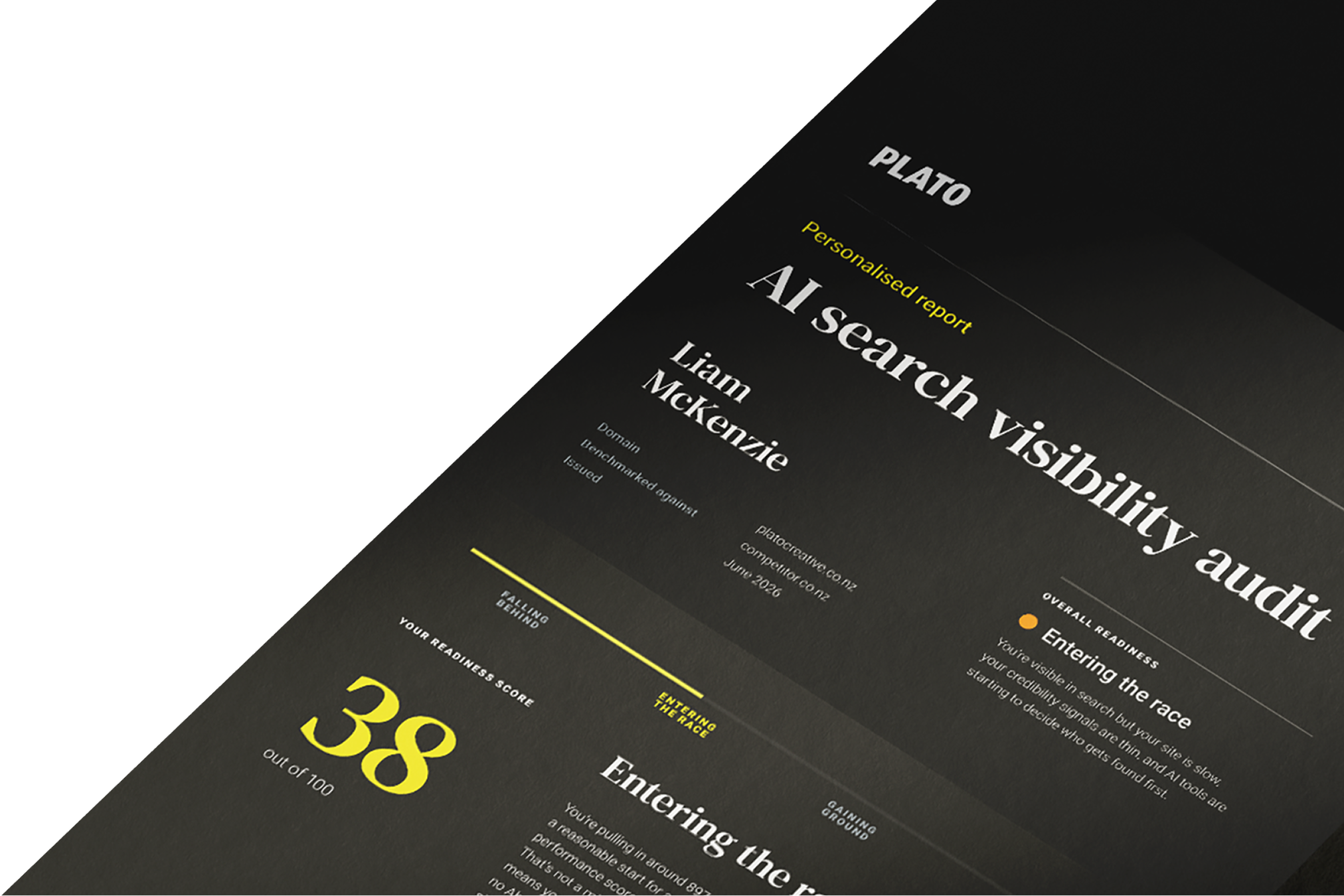
Curious how your business is performing in AI search today?
If customers are starting their research in AI answers, knowing whether your business is being recommended matters. Complete our AI Search Visibility Audit to understand how visible you are today and what practical steps could improve your presence across AI search.